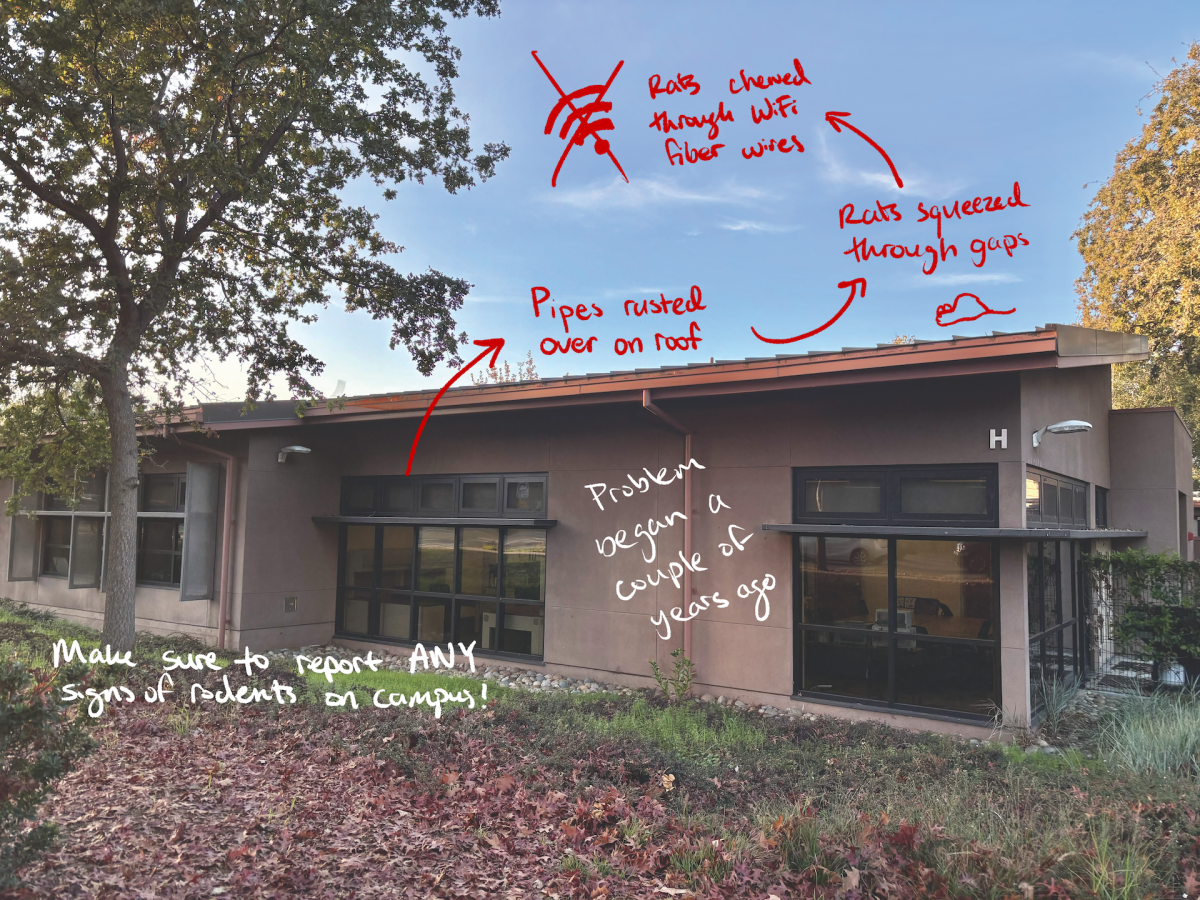
Rats have gotten into H-building classrooms over the past few months, disrupting lessons by chewing wires of both the Wi-Fi and temperature settings on two separate occasions.
According to head custodian Luciano Hernandez, the roofs of the H-building had pipes that rusted over, allowing the rats to squeeze through gaps in the pipes and chew through fiber cables that brought internet connection to surrounding classrooms. The Wi-Fi outage lasted for a few class periods this fall, but the issues started arising over the summer.
“Two of the things that rats need to survive are heat and food, and there’s plenty in at least a couple of the (classrooms),” he said. “We try to advise teachers not to have a lot of food in their class and make sure that everything is sanitized and disinfected.”
When there are issues with rodents or other animals on campus, the custodial team works to patch up property that was affected, ensure that no nests are left inside and set up traps as an extra layer of mitigation.
“I think that the (rats) affected the students more than us, be- cause we just go after and clean,” Hernandez said. “It’s just the idea that there might be rats in their (classes).”
According to Assistant Principal of Facilities Dr. Mycal Hixon, students and staff on campus should be encouraged to report any sightings of rodents as soon as possible.
“If you notice any rodents around, that’s something that we need to know to reassess the area or amp up the type of assessments that we’re doing, because there might be additional spots that they might be coming from that we’re not aware of,” he said.
For World Languages Instructional Leader Matt Hall, the rats have been an ongoing issue on and off for a couple of years.
“There have been at least two separate incidents where the rats damaged infrastructure to the point where instruction was impacted,” Hall wrote in an email. “(It wasn’t) the end of the world, but certainly a disruption.”
When rodents are detected on campus, the school and district launch a multi-step plan to rectify the situation.
“We had one of the rodent control companies come out and be able to assess the problem, trying to figure out what’s happening,” Hixon said. “So if there’s holes within the wall, or if they’re coming in some other way, we want to definitely patch up those potential holes. We would set up some aspects of traps, and then check again the next day to see if they’re going inside the traps, letting us know if there’s a bigger situation that we need to be concerned about.”
Hernandez also emphasized the importance of keeping the campus clean to reduce potential rodent infestation.
“When kids eat everywhere and they throw food, you’re going to have rodents,” Hernandez said. “If they can just dispose of food properly and try to do their best to clean up and throw everything in the trash, (it would help).”