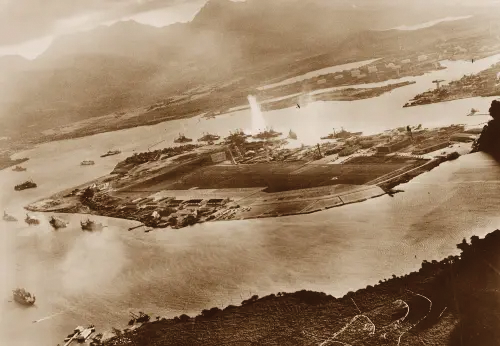
Grim plumes of smoke engulfed the naval base Pearl Harbor at dawn on Dec. 7, 1941, a somber shroud looming over the aftermath of an unforeseen attack by the Japanese Empire. As National Pearl Harbor Remembrance Day approaches to denote the 84th annual commemoration of those lost on this date, it is not only necessary to memorialize the soldiers and civilians in Oahu, Hawaii who passed away either at or near the scene of the attack, but also to recognize the rampant racism and discrimination against Japanese Americans that surged as a result.
The incident killed 2,403 Americans and wounded 1,178, burdening families with devastation. Of the 1,177 soldiers who died aboard the USS Arizona, only 107 ever had their identities confirmed. This significant lack of closure afforded to their lives only further stresses the importance of observing Dec. 7 as a day of remembrance.
Following the attack, President Franklin D. Roosevelt signed Executive Order 9066 on Feb. 19, 1942, authorizing the incarceration of Japanese Americans in order to mitigate their “threat to national security.” Forced into barracks with limited amenities and abusive authorities, more than 120,000 people of Japanese descent lost their livelihoods and basic freedoms as a result of the U.S. government’s prejudiced, fear-driven campaign. This highly unconstitutional Executive Order 9066 violated Japanese Americans’ Fifth Amendment right to due process and Fourteenth Amendment right to equal protection.
Furthermore, while Roosevelt’s executive order exacerbated the unjust imprisonment of Japanese Americans to this scale, the issue itself had also already been established earlier in the war. Using reasoning rooted in racism rather than thought, the government had been detaining Japanese Americans even before the attack. English teacher Diane Ichikawa, whose relatives the government had incarcerated in the camps, recalls her great uncle’s experience as a victim of this practice, affected even before the United States turned to mass internment.
“He was brought in (because they thought) that he was a spy,” Ichikawa said. “His wife was a Japanese national, and they had sent some money to her brother, who was starving.”
Discrimination against Japanese Americans prior to the attack was pivotal in determining its outcome. According to Foreign Policy Honors teacher Tara Firenzi, this prevalent prejudice hindered the strength of the U.S. military’s response to the attack.
“The lack of preparation (and) awareness that an attack was coming at Pearl Harbor was in part due to xenophobia and racism,” she said. “The military leadership in Oahu really thought that there was going to be (some) sort of mass sabotage from the Japanese Americans who were living in Oahu. They were so focused on protecting their harbor and their planes that they dropped the ball on protecting themselves against (external) attacks.”
In the decades that followed, Japanese American internment remained a taboo topic of conversation for both Japanese Americans and the wider public. Ichikawa observed this to be quite apparent while she was growing up, although discussing the subject gradually became more common as she got older.
“(My father) never talked about the camps,” she said. “Nobody in that generation really ever talked about it very openly, so it wasn’t until I was in high school and there was a one paragraph section in our history books about it (when) I asked him and he told me a little bit more.”
However, tiptoeing around dialogue about the internment of Japanese Americans is not a proper solution. Instead, Ichikawa encourages greater exposure to these difficult topics as a way to learn from past mistakes so as not to make them again. By incorporating more of these subjects into schools’ curricula, students and teachers can push back against the normalized bigotry spewed in society on a daily basis.
“We can’t sweep things under the rug and just not look at the ugly parts of our history,” he said.
Similarly, Firenzi stresses that gaining multiple perspectives from a certain point in time allows for greater objectivity in understanding what occurred.
“If we don’t look at everything and we can’t acknowledge the nuance, then we are probably going to fall prey to being told stories that come from only one side,” she said.