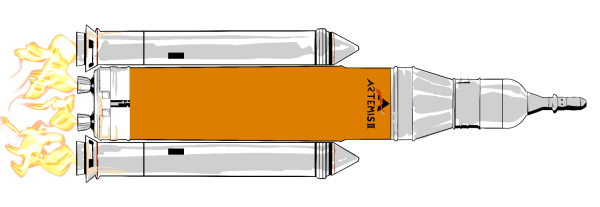
After Apollo 17’s successful mission to the moon in 1972, space exploration seemed to have come to a standstill. For fifty years after, no country sent any astronauts to the moon. But half a century later on April 1, 2026, the NASA Artemis II space mission finally broke the spell. The 10-day mission sent four crew members aboard an Orion spacecraft looping around the moon, within 4,600 miles of its surface. They traveled 250,000 miles away from Earth, breaking the record for the furthest any humans have ventured into space. It was also the first mission to take a crewed flight beyond low Earth orbit since Apollo 17.
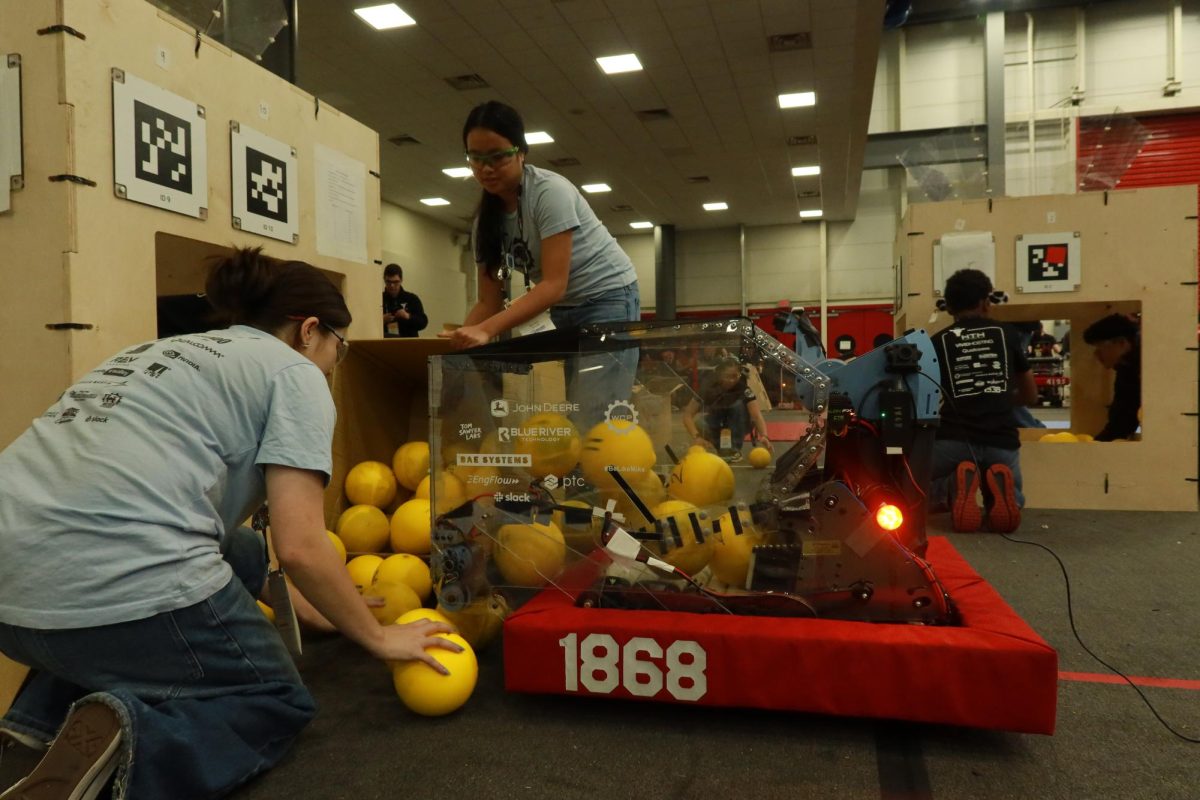
Gunn Robotics member sophomore Shrishti Sinha watched the launch during a robotics competition, which was exciting as a student in STEM.
“In one of our (robotics) competitions, there were so many students from different schools working and they played the Artemis II landing,” Sinha said. “It was this moment where everyone dropped what they were doing to watch the launch of Artemis in awe.”
Conceptual physics teacher Laurie Pennington emphasizes the importance of the space mission, especially having grown up hearing discussions centered around space travel and watched the 1972 launch of Apollo 17.
“When I was a kid, everybody was pretty excited when we would go to the moon,” Pennington said. “I think that interest has been lost since Apollo 17, (because it’s) ‘out of sight, out of mind.’”
Junior Aeronautics Club president Tony Wu views Artemis II as a huge accomplishment and says the launch has altered his club’s perspective on space.
“The only impressive launches in our lifetimes as high schoolers were just random SpaceX rockets, but to see an actual NASA rocket go to the moon (is huge),” he said. “I thought we were never going back (to the moon).”
According to Sinha, from a robotics perspective, the Artemis missions are what young engineers like her aspire to work on one day.
“It’s just really cool,” Sinha said. “We’re just working on robots, and it’s a very small space, no matter how big it seems in Silicon Valley. It’s barely the tip of the iceberg, and Artemis II is kind of what we could be.”
From monitoring human health to materials engineering for the rocketship, every detail was carefully thought out and backed by cutting-edge science.
“The mission aimed to check out human long-term health (in space) using Avatar, which tracks conditions with a wristband and Archer, another thing that tracks sleep health and deep space,” Wu said. “There’s a lot of technical stuff that went into it.”
A Virtual Astronaut Tissue Analog Response was an investigation that studied the effects of microgravity and increased radiation on human health using organ chips, and one of the many health studies completed for Artemis II. Other studies analyzed the blood and saliva samples of crew members to track biomarkers of stress and immune suppression, to monitor their health and study the biological reactions of humans in space.
Beyond space exploration, the mission contained many other firsts. Mission specialist Christina Koch was the first female astronaut to fly into deep space. Pilot Victor Glover was the first Black astronaut to fly into deep space and was previously also the first black astronaut to live aboard the International Space Station. Mission specialist Jeremy Hansen was the first Canadian and non- American to participate in a lunar mission.
Pennington is optimistic for future racial and gender breakthroughs in space exploration.
“Sometimes, younger generations don’t think that they’re the kind of people who (can make) these big scientific achievements,” she said. “This type of representation (allows) young people (to) see themselves in those people.”
To Sinha, the mission showcases curiosity and how discovery can bring people together.
“It’s great that we can put (political controversies) aside for the sake of discovery and innovation,” Sinha said. “We really are just on this one earth in the middle of the universe. It shows us what really matters.”
Pennington emphasizes the significance of Artemis and returning to space exploration for young people.
“I think it’s about the possibilities it opens up for future generations,” Pennington said. “I’m really happy that we’re still thinking about it.”
Wu is excited for the future of space exploration and what the Artemis II mission means for it.
“I’m hopeful,” Wu said. “The success of Artemis II means that Artemis III, IV and V — the ones that plan to launch onto the moon and make it so we can potentially live on the moon — are still in the realm of possibilities.”
—Written by Ellen Kim