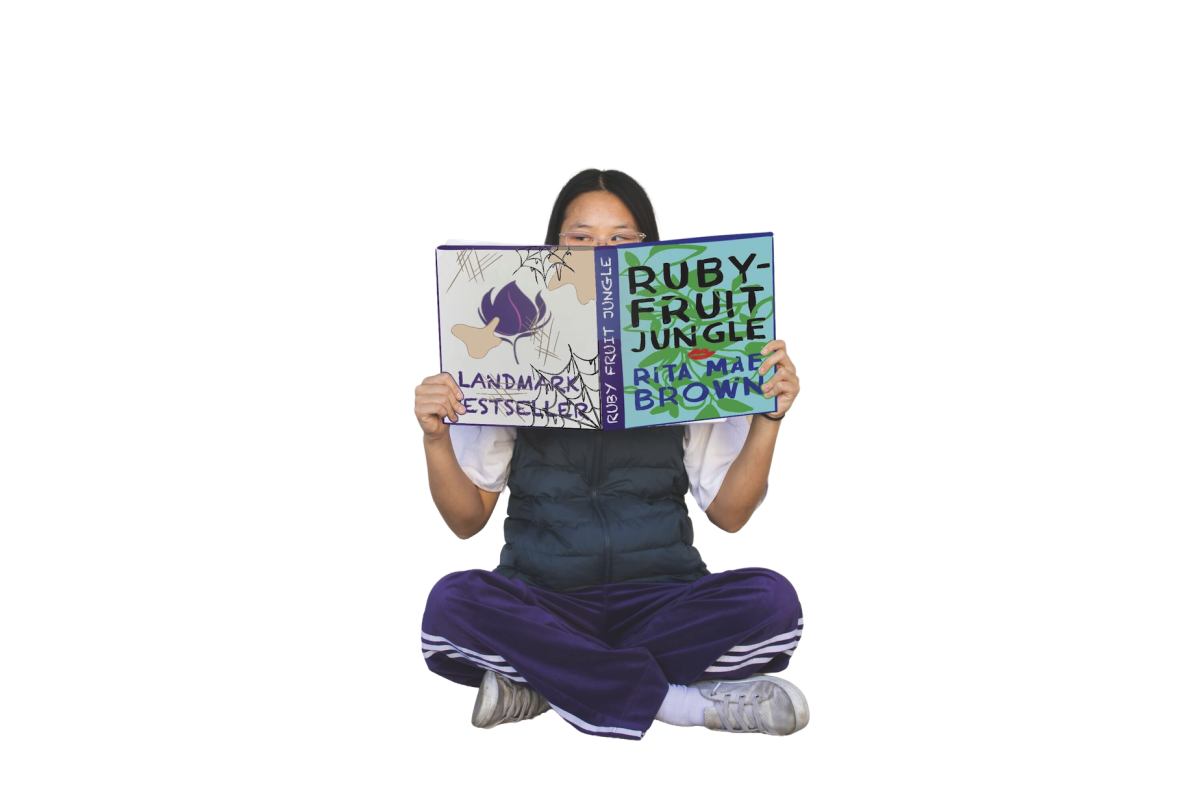
The Oracle staffer Melody Song went to the library, found a book that has never been checked out and reviewed it.
Although relatively unheard of by younger generations of readers, “Rubyfruit Jungle” by Rita Mae Brown is often considered a classic in literary circles — at least established enough to warrant a SparkNotes page. Published in 1973, it follows a young girl named Molly Bolt, who comes of age in the ‘50s. On the surface, Molly seems to have it all figured out: excellent grades, class president and a full ride to the University of Florida. Secretly, though, she feels more alienated.
Molly has known from a young age that she likes girls instead of boys. Privately, she’s never had any qualms about her sexuality. Publicly, though, she stays discreet. Still, that doesn’t stop the scholarship committee from discovering her relationship with her roommate and rescinding her financial aid. Unable to continue her education, she heads to the city. After all, “there are so many queers in New York that one more wouldn’t rock the boat.”
In the Big Apple, she badgers admissions officers and finds her way into New York University, shielding her dream of being a Hollywood director from assailants in the form of bitter lovers, bigoted professors and crippling poverty. Is this when she will finally break?
Through Molly’s internal monologue, Brown strays away from traditional values and conformity. Through Molly’s intense authenticity and self-belief, readers come to understand a worldview that is both childlike and wise in its simplicity. “I don’t feel like having to fight until I’m fifty,” she thinks. “But if it does take that long then watch out world because I’m going to be the hottest fifty-year-old this side of the Mississippi.” As art historian Jonathan D. Katz put it: “(Molly’s) story, for all the struggles it contained, was about something we hadn’t yet even named: queer joy. No wonder it shepherded so many coming out; it made queerness heroic.”
Her bravery, after all, is contagious. As readers, we live vicariously through characters, with the most attractive being ones who make you feel like a greater person than you currently are. To inhabit Molly Bolt is to live fearlessly, trust yourself completely and devote yourself entirely to chasing your dreams. “I’m the hottest thing since Eisenstein; they’re lucky to be able to help me in my formative stage,” she tells herself.
Even so, “Rubyfruit Jungle’s” merits are not limited to the protagonist. As a lesbian author writing about a lesbian protagonist, Brown also finds ways to celebrate womanhood, criticizing misogynistic social institutions and cultural phenomena including marriage, higher education and workplace harassment. For anyone worried, this novel has no man-hating agenda — Molly’s father is a trustworthy, dependable character, encouraging her to go to college and pursue her dream of becoming a director. This novel is simply committed to a single idea: a “pure” feminine existence, completely liberated from the patriarchy.
Yes, “Rubyfruit Jungle” is for the girls and the gays, but in there is a message for everyone because insecurity and fear don’t discriminate. It is a reminder of the miraculousness of life and a call for everyone to live honestly despite what society thinks, because the person you are is more special and valuable than anyone you could ever pretend to be.