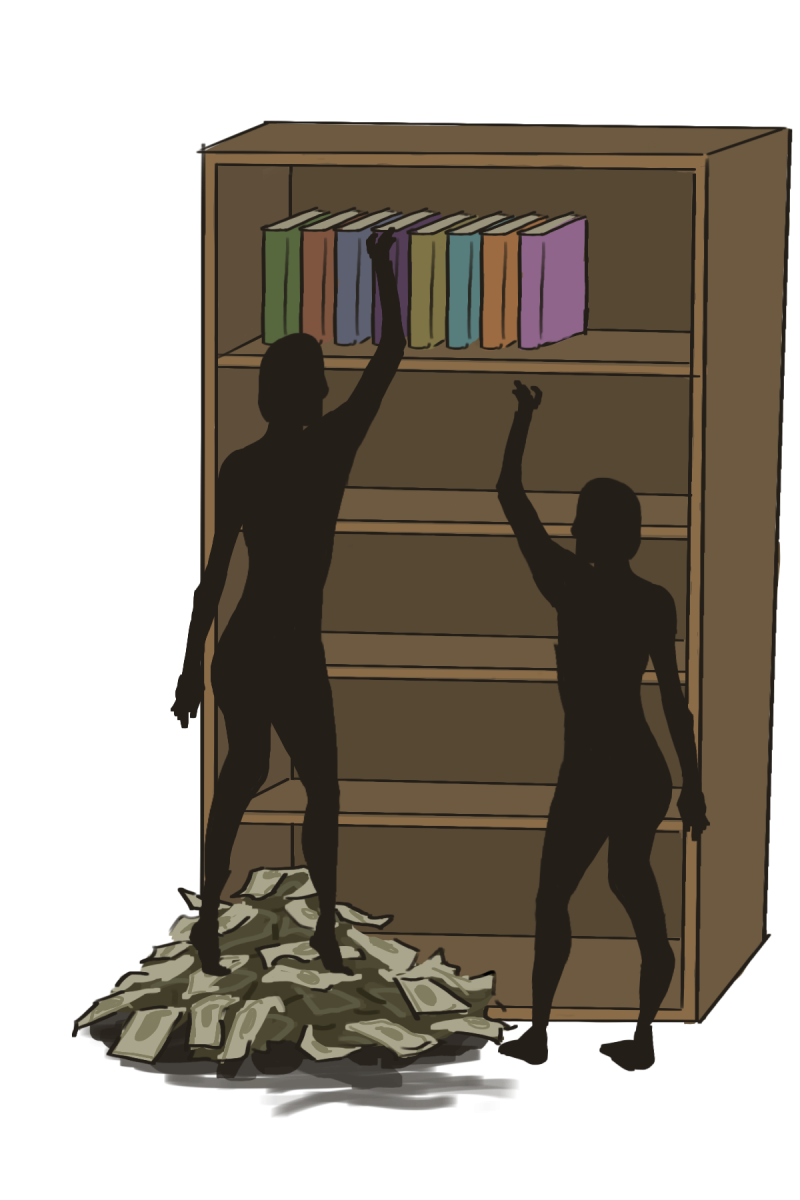
Knowledge has the power and potential to advance technology and medicine while simultaneously addressing global issues, yet it is often treated as a commodity rather than a shared resource. Research is meant to spread ideas and rapidly drive progress, yet it has become a restricted asset that limits who gets to learn and innovate. People should not have to pay for knowledge or information.
Without open and public access, knowledge becomes a barrier rather than a tool. According to the National Science Foundation, in 2022, up to 40% of basic research is funded by the federal government, yet the results are often placed behind high-cost fees. This creates a system where the people have to fund research with their taxes and pay again to access it. According to The Harvard Crimson, fees to read an individual article can often cost more than $40. With over half of academic research locked behind high- cost paywalls, knowledge has become a privilege that many cannot afford.
Beyond research, restricted access to knowledge greatly contributes to educational inequality. Even throughout wealthier nations, millions of students lack access to textbooks, academic journals and reliable learning materials simply due to the cost barrier. According to UNESCO, over 250 million children worldwide still lack access to basic education. Restricting educational access only widens this gap, leaving students who are outside of privileged and elite institutions at a significant disadvantage.
Free knowledge also stimulates and plays a crucial role in innovation. With free information on the internet, individuals from diverse background and experiences can collaborate and contribute to new ideas and perspectives. However, studies have shown that freely accessible research is more widely used and has greater reach. For instance, the National Library of Medicine has shown that open-access articles receive 18% more citations on average compared to paid articles. This demonstrates that increasing accessibility also increases visibility and impact on the public. Organizations such as NASA have reinforced this idea by releasing decades of research, satellite data and software, therefore accelerating scientific discovery and an improved understanding of the Earth and space. By contrast, restricted access slows progress by limiting who can build upon the perspectives and ideas behind the barrier of finances.
An issue that may arise when knowledge becomes free to the public is reduced incentives for creating high- quality, rigorous work. If researchers and institutions no longer profit from their research, many argue that funding and publishing could decline, potentially lowering the quality of content produced. Academic journals’ annual subscriptions cost upward of thousands of dollars, and removing these revenue streams may disturb the sustainability of the work.
While from afar it may seem like the quality of research would deteriorate, this perspective overlooks how academic knowledge is actually produced. Most research is not driven by the need for money, but rather by the desire for discovery and real-world impact. Researchers are often not paid for their success in their papers, but instead funded by universities, grants or government institutions. For example, the U.S. National Science Foundation has provided over 9 billion dollars to support research and education. This means that the incentive to produce high-quality research is independent of earning a profit. With this, restricting access does not create more informational knowledge, but simply controls who can see it.
Another concern that arises with free knowledge for the public is that the information can be misused or misinterpreted. However, restricting access is not an effective solution and can worsen misinformation since it makes it more difficult for individuals to verify claims from free, credible sources. Studies show that it is rare for individuals to purchase academic research, and would rather rely on more easily available, but less reliable sources like social media. In a 2018 MIT study, false news reached people six times faster than the truth. If a paywall barrier is built upon this already existing problem, the likelihood of misinformation spreading is significantly higher because the most credible articles that could fight it are ignored.
To ensure that these issues are being addressed, institutions and the government must shift toward regulations and policies that prioritize accessibility over profit. Requiring that information is government-funded and credible, while also being publicly accessible, would ensure that society has equal resources and benefits from research. It is also important that publishers can expand reliable open-access platforms to reduce dependency on free options, as they exclude large portions of society.
While implementing these challenges on a global or national scale presents challenges such as unwillingness or lack of cooperation, if people have to continue to pay for research, disparities will persist and knowledge will remain concentrated in only specific communities and groups of people.
The restriction of knowledge and information through the aspect of money does not just limit access to certain communities, but it also limits progress. When information is confined to only those who can afford it, discovery and innovation slow, inequality continues to worsen and opportunities are lost. Knowledge should be shared freely and used as a resource that is accessible to all, since it fosters a more inclusive environment for individuals from different backgrounds and experiences who can contribute to solving problems in the world.