As one of the biggest sporting events of the year the Super Bowl extends far beyond the field because of its scope. While millions of fans focus on the match up, the halftime show, commercials and local communities experience notable economic effects as thousands of visitors from all over the country travel to the Bay Area.
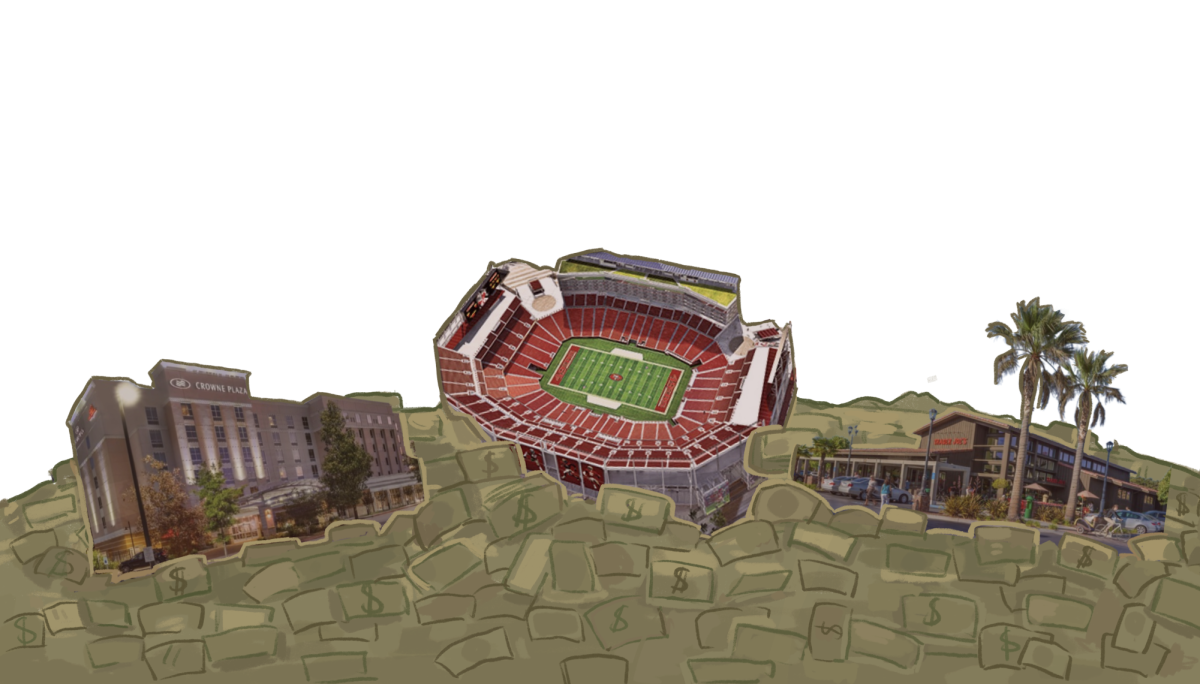
Although the Super Bowl will be played at the Levi’s Stadium in Santa Clara on Feb. 8, Palo Alto — situated a short drive away from the stadium — experiences spillover effects through hotels, restaurants and local businesses. Visitors need a place to eat, stay and spend time, creating both opportunities and challenges for the local economy.
According to the Louisiana Economic Department, Super Bowl LIX generated an estimate $1.25 billion in total economic output, with the combined visitor and vendor spending totaling $658.4 million. However, the event still involved significant investment, including over $70 million in infrastructure upgrades and $24 million for hosting. Alongside increased media attention these numbers can be a reason cities submit a bid to host the event.
Many football fans, like senior Min-Jae Kim, associates the Super Bowl with family traditions and team rivalries rather than the greater economic impact that it leaves.
“I don’t think students really think of the Super Bowl as more than a big game,” he said.
Still, even if students and fans do not actively weigh in on the economic aspect behind the event, its presence can be felt in subtle, indirect ways, like increased traffic, busier streets and more crowded local businesses throughout the area.
One of the most noticeable economic effects of the Super Bowl is its impact on local hotels. An increase in demand for rooms often begins months in advance, with the lodging seeing price fluctuations and being sold out the weekend of. According to Crowne Plaza Palo Alto by InterContinental Hotels Group, while prices usually stay around $142 to $230 in the days leading up to the Super Bowl between Feb. 4 and 8, the prices stay between $325 to $425.
Crowne Plaza Palo Alto hotel front desk worker Anne — who preferred to keep her last name confidential — verified the increased demand for rooms, explaining the hotel’s pre-planned procedures to deal with large-scale events.
“We’re basically sold out the day before, the day of, the day after, with rooms only being available the Friday before,” she said. “The amount of staff that we have, we’re prepared to handle this large volume of people. This hotel, in particular, is a business hotel, so we get a lot of corporate bookings. So along with that, we also get price increases.”
While hotels and certain local businesses may have a temporary increased revenue and demand, the overall economic impact is more complex. Economics teacher Philip Lyons explained that large sporting events like the Super Bowl often produce significant short-term gains, but do not always lead to long-term economic changes, and sometimes even have a negative impact.
“The amount of money that people spend to put these events on, they anticipate getting all this money back and more,” he said. “And what happens is they end up spending more than they generate, and long term, it’s a disaster. But there isn’t any proof to say it has a long term benefit, and it also depends on how much money you have to put in to run the event. If you only put in a small amount, then you can maybe have a benefit.”
The Super Bowl may differ from other large-scale international sporting events, such as the Olympics or the World Cup, which often require extensive new infrastructure. For example, according to CNN, for the Sochi Olympics in 2014, the budget was around $12 billion, but the actual cost ended up at an estimated $55 billion. The total cost surged due to large infrastructure projects such as new railroads, roads and several venues. In the Bay Area’s case, Levi’s Stadium has already been built, reducing the need for additional spending and leaving the possibility for a longer-term net positive for the area.
“The Super Bowl here in the Bay Area might work out because the stadium was already built,” Lyons said. “They don’t really have to do anything. So everybody just comes for one weekend, spends a bunch of money and leaves. So it might have a one-time short term impact, but I don’t think it’ll have a long term impact.”