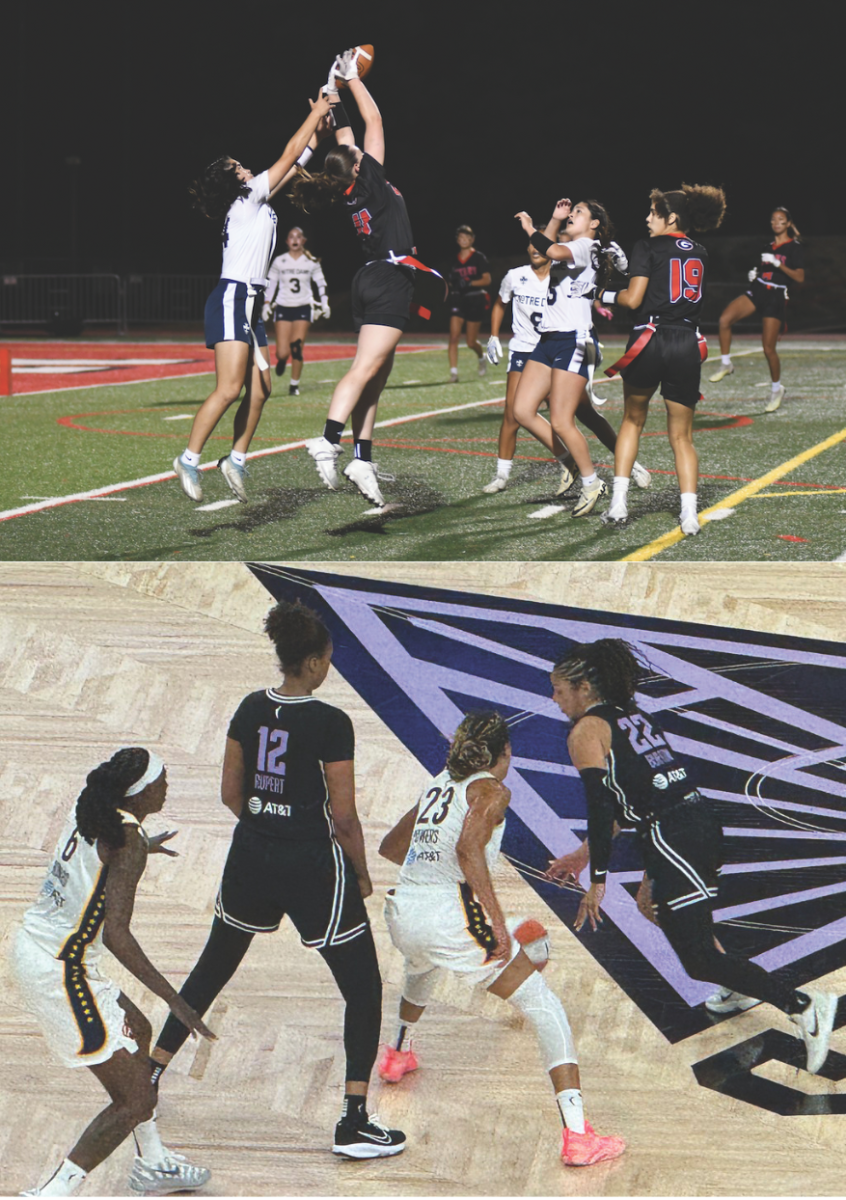
Student stands in Titan Gym were packed in support of the varsity boys basketball game vs. Paly on Saturday, Jan. 10. Just two hours before, for the girls’ game at 4:30 p.m., the audience was almost a quarter of the size, and the reception towards the former match was visibly less.
This favoritism is part of a larger national trend. According to a 2023 study by Wasserman’s “The Collective,” women’s sports make up only 15% of total sports media coverage. Moreover, certain sports take the spotlight. A 2024 survey from The Economist highlighted that 10% of U.S. sports fans’ favorite sport was soccer, 17% was basketball and 36% was football.
At Gunn, these patterns continue. Flag football captain senior Aliya Sidhu has noticed bias against her team, especially with resources. In some instances, while tackle football had full use of the field, flag football was not prioritized.
“Last year, for example, we would practice on the black tops or on the bad grass field with all the potholes, and people just kept getting injured or falling,” Sidhu said. “It was really hard to get a workaround to actually be able to practice.”
Both flag football and tackle football involve fields with end zones, forward passes and a “down” system which helps advance the ball down the field. The main differences are that flag football replaces tackling with de-flagging and has fewer people on the field. These similarities make the difference in student support between the two sports even more puzzling to Sidhu, especially since flag football has had a more successful season.
“We tried to get cheerleaders to come to a flag game,” she said. “And they’re like, ‘No, we can’t do that. We have practice.’ But they go to every single (tackle) football game.”
Turnout is also something girls lacrosse player junior Trinity Smith noticed, but attributed to the sheer scale of different sports.
“Track is a really big sport with more people (participating) so there are more people who go watch the games,” she said. “They have a food truck that shows up there, and it’s really cool, but you don’t see that stuff for lacrosse, partially because we just have fewer people.”
Smith found that the many instances where her sport felt unfavored could stem from miscommunication, like lights turning off in the middle of evening practice or two years of senior nights in different locations.
“In freshman year, our athletic director scheduled a middle school track meet (at the same time), so that made it difficult to set up for the senior night, and the track meet wasn’t even for our school,” she said. “And last year, we had to have our senior night at Paly, so not even at school (due to a home game for the Boys Lacrosse team), which was kind of frustrating.”
Lacrosse’s late practice and game times are also a factor that may dissuade both spectators and potential players. However, Athletic Director Justin Halas says that many factors go into the complicated scheduling process due to the number of events Gunn must host.
“Many coaches have full-time jobs and families, which determine the times they are able to hold practices,” he said. “Multiple teams often share the same facilities, so coaches must communicate and coordinate their schedules with other teams.”
Smith also added that despite the frustrations, she still appreciates all the efforts from the staff.
“All the athletic directors and school staff are definitely trying their best to help all athletes equally, but when it comes to teams as a whole, that’s when some unintentional favoritism might happen,” she said.