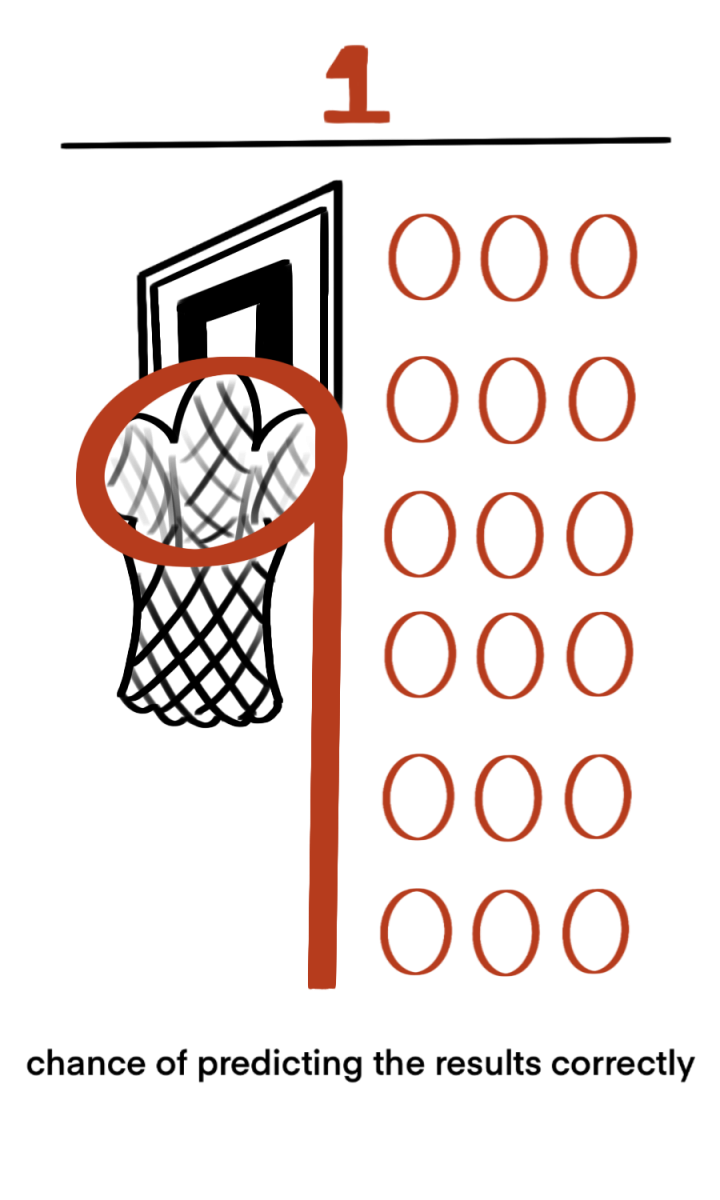
Roaring crowds, defeated champions and victorious “Cinderella” underdog teams define March Madness, the 68-team National Collegiate Athletic Association Men’s and Women’s Division 1 basketball tournaments. Behind the tournament’s chaos is the math behind countless
bracket predictions: Before the tournament, millions of fans predict who will win each of the 63 games in a ranked bracket layout competition, each aiming for perfection.
But a correct bracket is nearly impossible. The theoretical odds of a perfect March Madness bracket, with random selection of winners, are 1 in 9.22 quintillion. Even if utilizing in-depth analysis of the collegiate game, many factors eliminate most brackets halfway through the first day. Particularly, underdog “Cinderella” teams unexpectedly rise to victory against high-ranked teams early on. The fact that a single game decides who is eliminated and who moves on to the next round also introduces volatility, devastating brackets.
While using math can aid in sports analytics, math teacher Gopi Tantod believes victors in March Madness are extremely hard to foresee because of players’ variability. Calculating each athlete’s expected success in the team cannot always accurately predict players’ conditions and how they will work together on game day.
“It’s about who works with whom, and who can rebound off of each other,” she said. “You can do the analytics of (each athlete), but I don’t know if it would give you an accurate read (of who will win).”
As a Stanford D-1 women’s basketball point guard, Shay Ijiwoye helps prepare strategies for her team to work together efficiently and increase their odds against any opponent. Behind these strategies is another layer of mathematics, as prime defense requires forcing the opponent into low-scoring shooting positions. Offensively, analytics on where each athlete best shoots from play a deep part in predicting opponents’ patterns and building the best game strategy.
“(Predicting) and then dictating what an opponent does is kind of like one huge equation,” Ijiwoye said. “You’re trying to figure out how you can get (them) to do what you want them to do.”
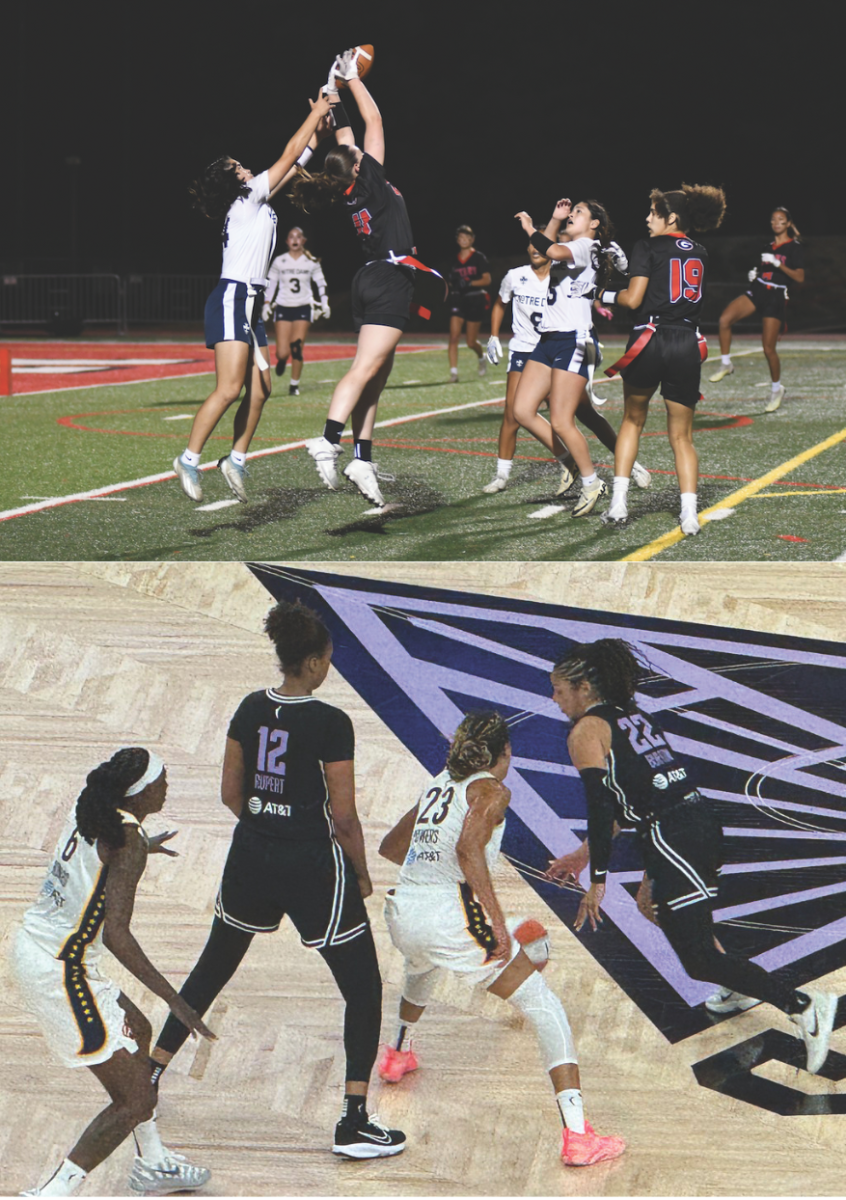
As complex strategy increases the stakes, so does viewership. In fact, women’s basketball has experienced record-breaking audience engagement in recent years, due to a shift in societal interest. Ijiwoye believes that March Madness offers an important platform to represent female athletes and empower the next generation, especially in a male-dominated field.
“When people think of March Madness, they mainly only think about men,” Ijiwoye said. “I think it’s so cool how people are paying more attention to the women’s side, and for people to see (all the different avenues towards professional women’s leagues).”
March Madness not only inspires female athletes but also offers a valuable time to bond with family. Girls varsity basketball point guard freshman Stella Kitch grew up playing and watching basketball with her dad and brothers. For Kitch, March Madness uniquely brings the basketball community together.
“My brothers sometimes come home (from college) to watch March Madness with us,” she said. “(The basketball community) is the kind of place where I can forget about all the stress of school, just hang out with my teammates, play (and watch) a sport I love.”
While the odds of a perfect bracket may not be in the predictors’ favor, the basketball community only grows stronger from the unpredictable chaos of March Madness. According to Ijiwoye, viewers bond over their March Madness predictions and favorite teams.
“Sending our (personal) stories is what makes (March Madness) even better,” Ijiwoye said. “When you have the personalities behind (the game), and you understand the different stories of people, people have empathy towards that. (The chaos of March Madness) is really refreshing, especially in the world we live in today.”