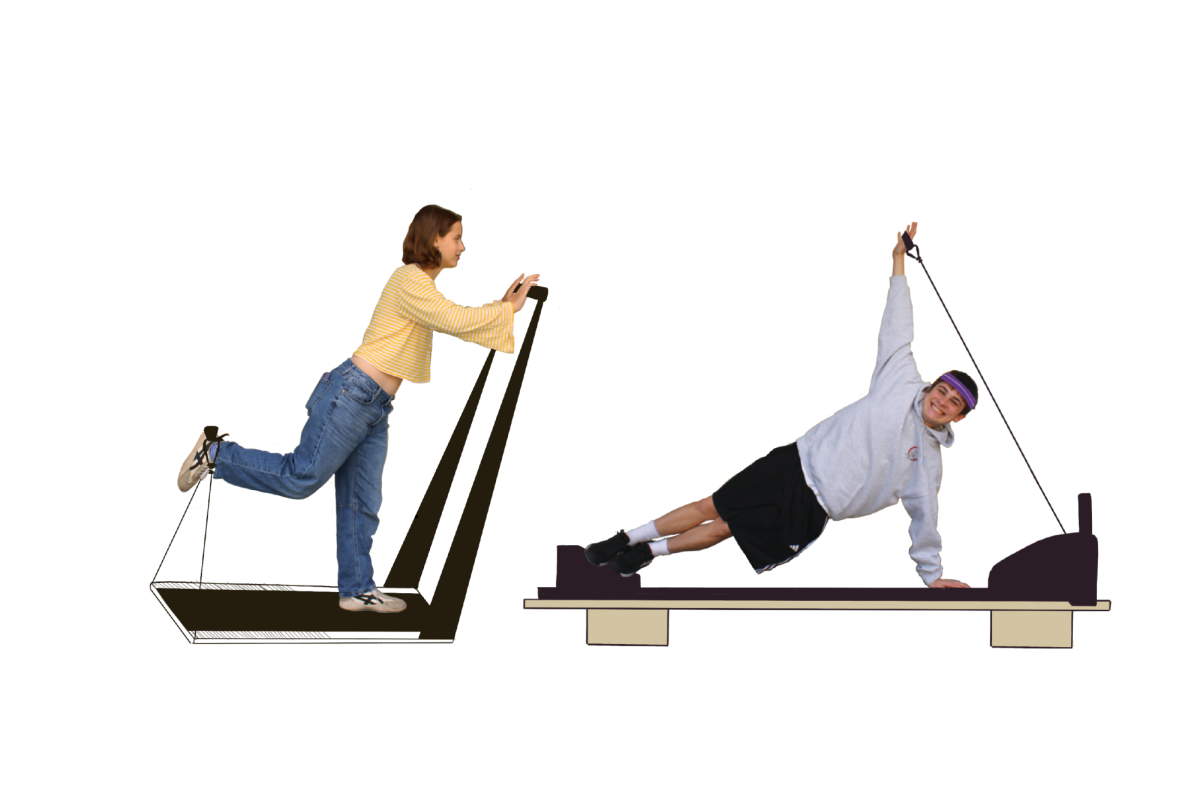
In the midst of the rainy winter months, we found ourselves looking for a new athletic challenge. Instead of continuing with our own sports or trying to be gym rats, we turned to a lighter and trendier activity: become Pilates princesses.
Pilates, named from its creator Joseph Pilates, is a mind-body exercise method that increases flexibility and reduces injury risk machine-based activity. It’s practiced by over 12 million people worldwide. We were in the dark about Pilates, having no prior experience, so it’s understandable that we were a little nervous as we walked through the doors of the Pilates studio, BODYROK. Although a couple of minutes late, we found our reformers, a Pilates machine focused on building stability, and got right to work, making the total number of people who practice Pilates 12,000,002.
At first, the type of movement demanded was disorienting and confusing. The reformer machine looked like a medieval torture device with its many straps and parts. We grabbed the wrong straps at one point and gave the techniques and exercises some of our own questionable, “creative” interpretations.
Nevertheless, after some much needed corrections from the instructor and following the lead of the people next to us, we started to get the hang of it. Don’t get too cocky once you start getting in the flow of things, though. One second, you’re doing an exercise that you could do all day, and the next you’re discovering new muscles all over your body that are a pain to have to move.
The reformer allows for a wide range of exercises, many of which are similar to those in the weight room, such as bicep curls and tricep pulldowns. Our set was composed of triceps, biceps, abductors and core exercises. Unlike some other training regimens, Pilates
is unique in its focus on control. At the end of the sets we were often instructed to do “pulses,” which were small, controlled, repetitive movements. We found that maintaining our balance was key: It turns out it’s very easy to fall over with two loose ropes in hand and only one knee on the machine. The core exercises were especially grueling, requiring us to hold strained positions for what felt like an eternity.
Maintaining good balance and form is key when it comes to a successful Pilates session, but don’t forget to keep the energy high and the vibes strong: Our Pilates room was complete with colorful lights, motivational mixes on Spotify and an aura that makes you feel like everything’s going to be okay, even when you’re ready to keel over as blood rushes to your head.
Pilates is a rewarding experience. For 40 minutes, there’s no time to focus on anything going on outside of the studio. All your concentration goes into doing the exercises, listening to the instructor and comparing your abilities to the middle-aged women around you. It is nice to just live in the moment, albeit a moment filled with excruciating core soreness (or other description of lactic acid filling the muscle). If it helps, time goes by very fast when hours get sliced into minutes get sliced into short workouts.
Pilates isn’t for everyone. This is just one of those books, though, that you can’t judge by its cover. It’s worth trying Pilates at least once.