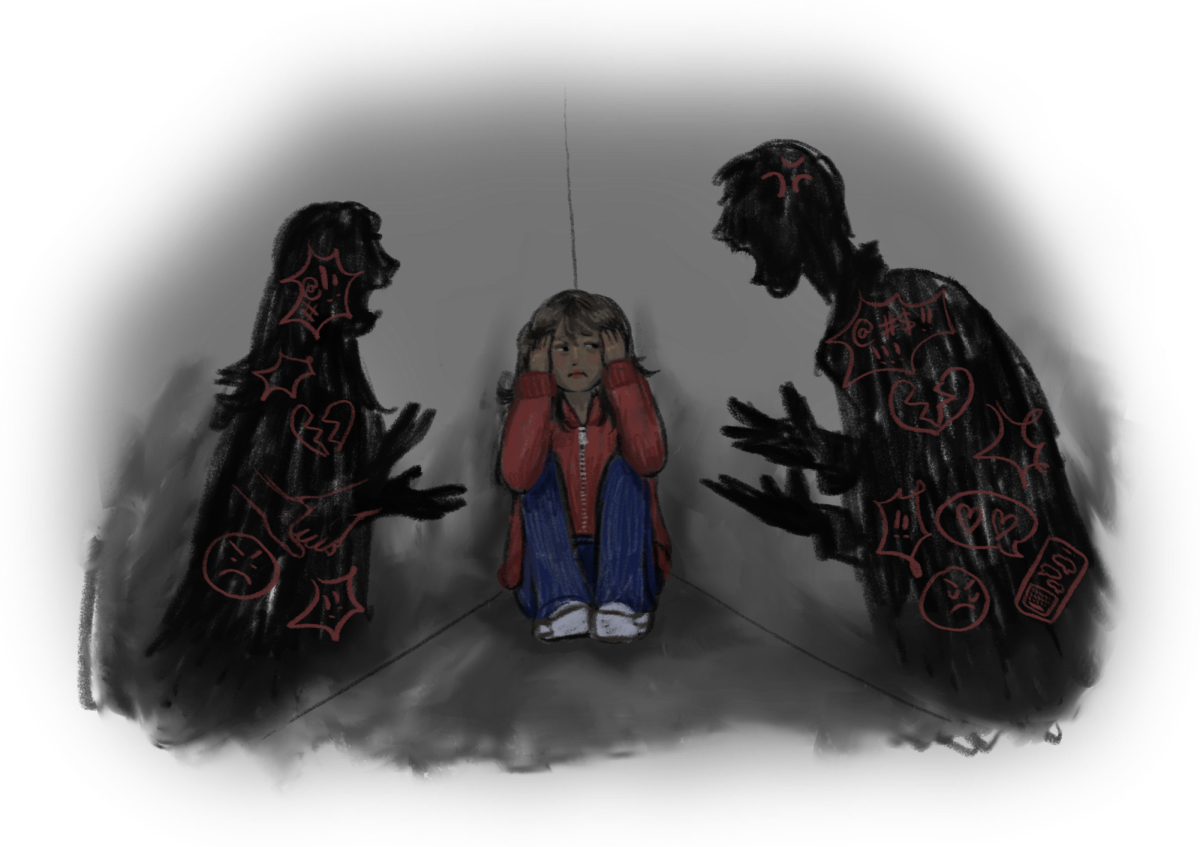
The first time senior Jonathan Miller (name changed to protect the student’s identity) saw the word “homewrecker” was in sixth grade, when he caught a glimpse of a text sent from his mother to his father. At that age, he was unaware of how this foreign word would change his family completely. Later, he learned that his father was having an affair, and his mother had already known, shielding her sons from a sadness she had largely been carrying on her own. After finding out, Miller didn’t speak to his father for a year.
“It was a very depressing time for her,” Miller said. “The person she had been married to for 23 years had decided to cheat on her. My mom explained to me that it was difficult, especially not being able to show how sad she was to my brother and me because she didn’t want it to rub off on us.”
Today, Miller says he looks to move past the experience, even if the way to healing means learning to live with what changed over time.
“I don’t see (the effect of the situation) in a bad way because I try not to let the past impact (me),” he said. “I would say (it) caused me to be a little less sensitive. I feel like things that used to bother me just don’t anymore, and I lost a lot of joy for things I used to enjoy, which could be good or bad.”
Understanding Infidelity
Infidelity is often defined as a breach of trust — whether romantically, emotionally or sexually — within a committed relationship. Frequently in such situations, children observe changes in family dynamics before understanding what is truly happening, according to
marriage and family therapist Natalie Shahar.
Miller’s mother initially sheltered him from the full story about his father’s infidelity. But even without details, he sensed instability.
“I could notice patterns with him, like spending less time with (the family and) his mood switched, like he would get really angry really easily,” he said.
Miller’s experience reflects a situation many students say they have seen within their own families or social circles. In a student poll sent to Gunn students with 96 responses, 1 in 4 students reporting knowing at least one person whose parents have participated in infidelity, not including other forms of parental conflict such as misusing money, chronic disrespect or stonewalling — a persistent refusal to communicate or interact.
Emotional Impact
While Miller doesn’t personally hold a grudge towards his father, he mentions that his brother has struggled much more with the family situation, being on ongoing difficult terms with his father and needing to release his emotions through conversations much more frequently.
“(My brother) is really sensitive, so it was a very difficult time period for him,” he said. “I’ve already forgiven my dad, but I think my brother still holds some grudges against him, because they seem to fight a lot more than I do (with him).”
This range of emotional responses largely stems from what psychology teacher Warren Collier calls “observational learning” or the acquiring of behaviors, skills and attitudes by watching others. Conflict resolution, for example, is one process that, when modelled in a certain way, can have long lasting impacts on children’s development.
“Children learn from their parents, not just what the parents are directly teaching them, but also what they see happen in the household,” he said.
An attachment style is the way people relate to others in relationships. According to the American Psychological Association Dictionary of Psychology, they can be broken into Secure and Insecure styles. Shahar says that immediate and long-term mental impacts in children after discovering parental infidelity ranges widely, depending on the child’s attachment style.
“You can see children who are over-pleasers because they don’t want to create more challenges in the family,” she said. “(Others) actually do the opposite (and) become very defiant and angry at the world because they feel so unsupported. (Others) withdraw and become more
depressed. (Some) become more anxious and develop (those) anxious attachment styles and relationships in their lives.”
From his experience, Miller believes that many other characteristics are involved in how one is impacted by their familial struggles.
“All of it matters, like (a person’s) friend group, even them being the first child,” he said.
Relationships
When children witness betrayal or persistent conflict in their parent’s infidelity-affected marriage, trust and perception in their own relationships are often reshaped.
“Children can sometimes have long-lasting trust issues if they see their parents divorce, separate or have frequent conflicts,” Collier said.
While Miller says he doesn’t consciously struggle because of what happened, he notices patterns on how the experience has influenced his approaches to navigating his social circle.
“I lose trust pretty easily,” he said. “I’m pretty selective with the people I tell things to and I feel like I find it hard to trust people.”
Within the family, Shahar has seen children wrapped up in issues regarding their parent’s infidelity, with their parents’ dishonesty and actions significantly altering internal bonds.
“There could be cases where the child feels very much deceived,” she said. “It creates a sense of (not) knowing what was real (or) authentic. If their parents have been lying to them, the child can start questioning themselves (and) it can create a real rupture in that attachment and the bond with the parent.”
Miller remembers a neighbor telling him he had seen his now-stepmother entering their house. When Miller confronted his father about it, he was met with anger and denial.
“It was just worse that I knew that he was lying at that moment,” he said. “So I (thought) like ‘How many other things could he have lied about to me?’”
Although their relationship has not fully returned to what it once was, Miller says he’s learning to cope with the situation in his own way.
“I kind of just tried my best to avoid myself from everything,” he said. “I feel like that probably plays a role in who I am now because I feel like a lot of people talk to their parents about stuff, (but) I’ve never really been able to do that.”
Healing
This effect on children is not exclusive to infidelity but also attributed to a range of parental conflict and parenting styles. While teaching the Social-Emotion Development segment of the AP Psychology curriculum, Collier makes his students reflect about the traits of their parents and parenting styles. He says this allows for children to not repeat the mistakes their parents made and allow for healing.
“That’s a really, really important question for children to ask themselves eventually, (because) if we just autopilot through life, then we usually just end up repeating (our parent’s negative behaviors),” he said.
For a similar reason, Shahar recommends therapy or counseling as a tool for teenagers in many of these cases in order to better understand the situation and one’s feelings regarding it.
“I think especially with teenagers, when there is so much embarrassment and shame involved, having a safe space where they can talk through and express all their range of emotions, (whether) it’s guilt (or) anger (or) pressure, (is huge),” she said.
Shahar says that this form of healing is not limited to talk therapy, but can include other outlets such as art and music.
“The idea is being able to externalize, rather than internalize all the emotions that we’re having, and that helps us get more clarity,” she said.